
Avoid These 5 Costly Real Estate Investment Mistakes
Every week, almost without fail, I sit with someone making the same five mistakes I’ve seen for over two decades. The faces change, the projects change, but the patterns stay remarkably consistent. So let me walk through the real estate investor mistakes to avoid that I genuinely wish more people knew before, not after, they sign anything.
None of these come from a textbook. They come from actual conversations across years of doing this.
Mistake 1: Trusting the Pitch Instead of Verifying the File
This is the one I see most often, and it’s the most preventable. Someone meets a confident salesman, hears a compelling story about a project, and gets excited enough to skip the part where they actually check the file, the NOC status, and the developer’s history themselves.
A pitch can sound completely convincing and still be built on a project with no real legal standing. The only real protection is verification, done personally, before any payment changes hands.
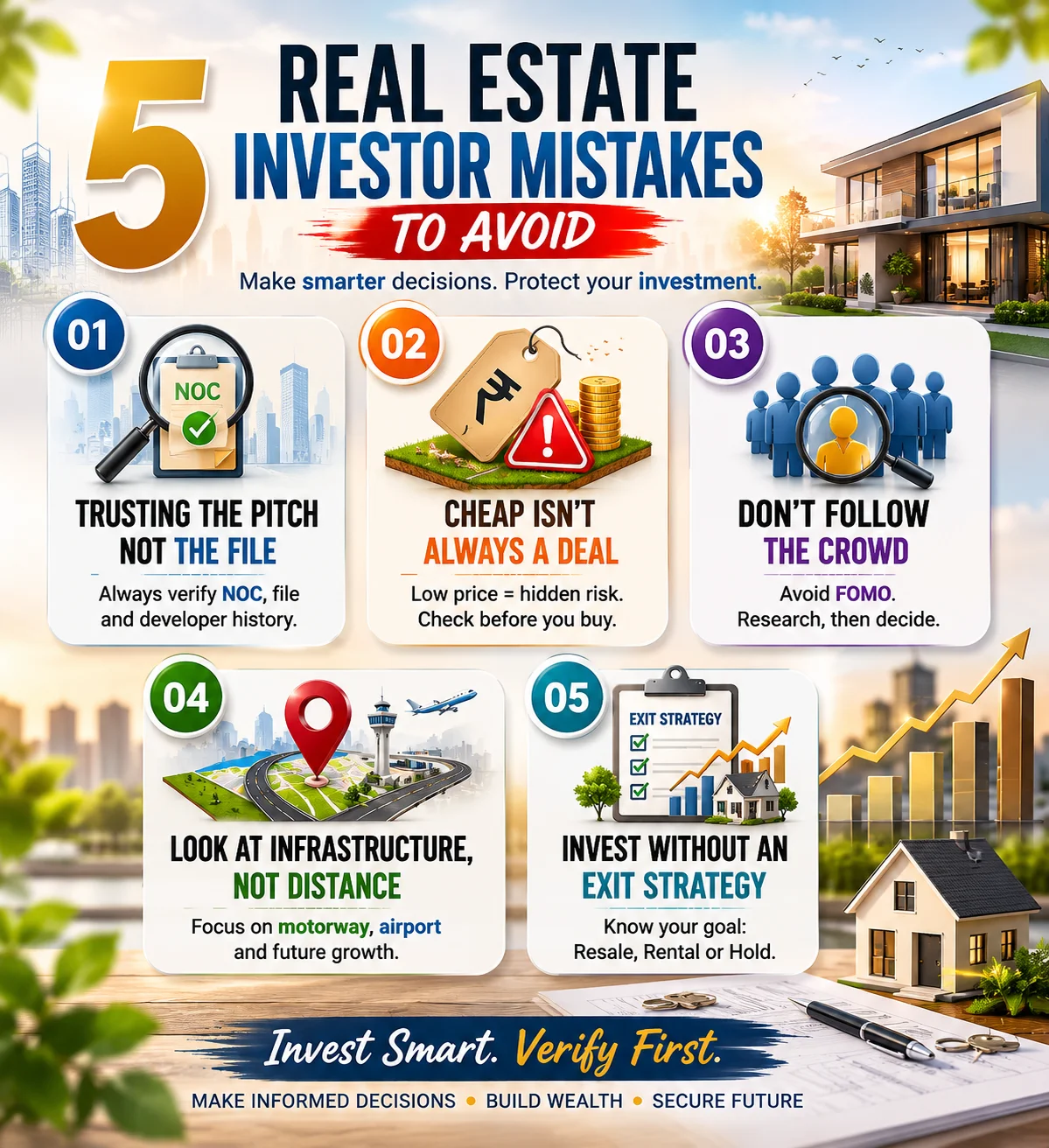
A simple visual guide showing the most common property investment mistakes and how investors can avoid them.
Mistake 2: Chasing the Cheapest Plot Without Checking Why It’s Cheap
New investors often equate a low price with a good deal. In my experience, it’s usually the opposite. A plot priced well below market value is almost always cheap for a reason, missing NOC approval, no real development progress, or disputed ownership.
|
What New Investors See |
What’s Actually Happening | The Fix |
|
“This price is amazing” |
Project may lack NOC or face legal issues | Verify NOC and development status before comparing price |
| “Everyone says it’s a great deal” | Social proof, not due diligence |
Check facts independently, not group sentiment |
| “It’s cheaper than the neighboring society” | Often reflects real, unresolved risk |
Ask why directly, and confirm the answer officially |
Mistake 3: Buying Because “Everyone Is Talking About It”
I understand the pull. When a project is everywhere, in conversations, on social media, in WhatsApp groups, it feels like missing out would be a mistake. But I’ve watched this exact pressure push people into societies that don’t actually fit their financial timeline or goals.
FOMO is not a strategy. It’s an emotional response that good marketing is specifically designed to trigger. The investors I respect most are the ones who can sit through that noise and still ask, “does this actually fit what I need?”
Want One-to-One Consultation with Expert Team of Gondal Group of Marketing?
Contact Now !
Mistake 4: Looking at Distance From the City Instead of Distance From Infrastructure
New investors frequently judge a location by how far it is from Islamabad’s city center. That’s the wrong measurement. What actually drives long-term value is proximity to a motorway interchange, the airport, or planned infrastructure like the Ring Road.
I’ve seen properties technically “further” from the city outperform ones that were closer, simply because of what was being built around them. Infrastructure, not distance, is the real signal.
Mistake 5: Investing Without a Clear Exit Strategy
This is the quiet mistake, the one that doesn’t show up immediately. Someone buys a plot or a unit without deciding upfront whether it’s meant for resale, rental income, or personal use. Then, two or three years later, when the market shifts or they suddenly need liquidity, they’re stuck without a plan.
Before buying, I always ask clients one simple question: what does success look like for this specific investment, and when? If they can’t answer that clearly, we slow down until they can.
Why These Patterns Repeat
None of these mistakes come from people being careless. They come from excitement, trust, and the natural pressure of a fast-moving market. My job, more than just selling property, has become helping people slow down enough to avoid these five exact traps.
Let’s Make Sure You Don’t Make These Mistakes
If you’re considering an investment and want someone to walk through it honestly with you, including telling you if something doesn’t look right, I’m happy to have that conversation.
Get in touch for a consultation, and let’s make sure your next investment avoids these five common mistakes.
Frequently Asked Questions
- What’s the most common mistake new real estate investors make?
Trusting a salesman’s pitch without personally verifying the property file, NOC status, and developer history before committing any payment. - Why is a cheap plot often risky?
A significantly lower price usually reflects an underlying issue, such as missing NOC approval, stalled development, or unresolved ownership disputes, rather than simply being a great deal. - How can I avoid FOMO-driven property decisions?
Slow down and evaluate the project on its actual fundamentals, location, NOC status, and developer track record, rather than how much attention it’s receiving on social media or in conversations. - What should I look at instead of distance from the city center?
Focus on proximity to real infrastructure, such as motorway interchanges, the airport, or planned projects like the Ring Road, since these factors drive long-term value more reliably than raw distance. - Why does an exit strategy matter before investing?
Knowing upfront whether you’re investing for resale, rental income, or personal use helps you make better decisions if the market shifts or you need liquidity later.
Written by Mr. Nasir Gondal, Real Estate Expert & Business Mentor
This Content is Updated on Date: June 28th, 2026