
What 23 Years in Real Estate Taught Nasir Gondal
People often ask me what changed the most over my career. They expect me to talk about prices, or projects, or how much the market has grown. Honestly, the real answer is simpler than that. Looking back on 23 years in real estate, the lessons that actually changed how I invest weren’t about numbers at all. They were about patience, judgment, and people.
Let me share the seven that shaped me the most.
Lesson 1: The Biggest Losses Come From Rushing, Not From Bad Markets
Early in my career, I assumed the riskiest decisions would come from picking the wrong project. I was wrong. The costliest mistakes I made, and watched others make, came from not waiting long enough to verify before committing. A bad market corrects itself over time. A rushed decision rarely does.
Patience stopped being a personality trait for me and became an actual investment strategy.
Lesson 2: A Good Location Always Survives a Bad Market
I’ve watched certain societies hold their value through slow years purely because of motorway access or proximity to real infrastructure. Meanwhile, projects that were heavily hyped at launch, but sat in poor locations, quietly faded once the excitement wore off.
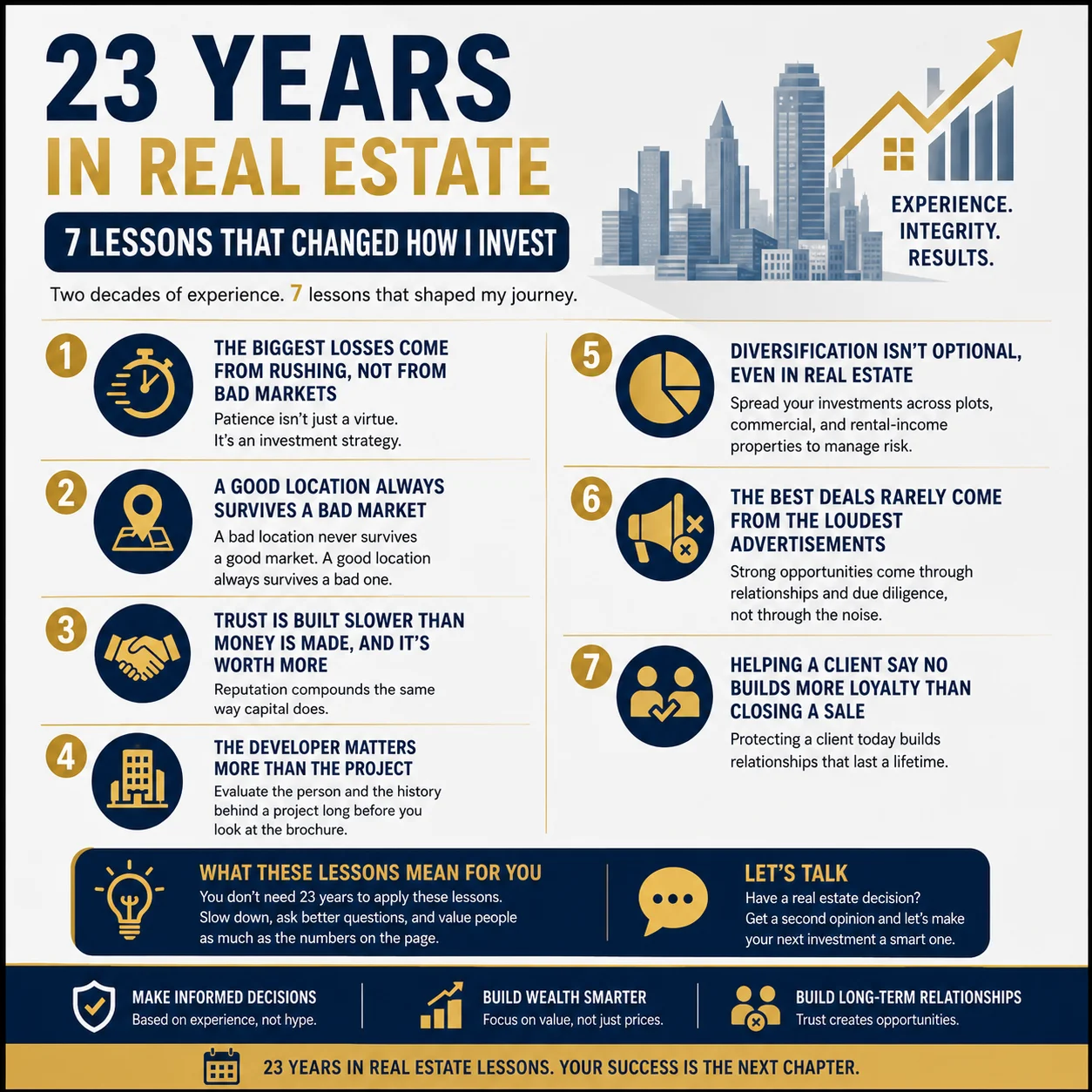
After 23 years in real estate, these 7 timeless lessons continue to guide smarter property investments, stronger client relationships, and better long-term decisions. Learn from experience instead of costly mistakes.
A bad location never survives a good market. A good location always survives a bad one. That distinction took me years to fully internalize, but it’s never failed me since.
Need Consultancy Services from Our Experts?
Contact Gondal Group of Marketing Team Now!
Lesson 3: Trust Is Built Slower Than Money Is Made, and It’s Worth More
There was a point early on where one client, after years of honest dealing, brought in more business through word of mouth than any advertisement I ever ran. That moment taught me something marketing budgets can’t buy.
Reputation compounds the same way capital does. Slowly, quietly, and then all at once.
Lesson 4: The Developer Matters More Than the Project
I once watched two projects with nearly identical paper specifications perform completely differently, simply because of who was building them. Same plot sizes, same location quality on paper, entirely different outcomes.
|
What Looked Similar |
What Actually Differed | Result |
|
Plot sizes and pricing |
Developer’s track record | One delivered on time, one stalled |
| Marketing materials | Financial discipline of the developer |
One held value, one lost investor trust |
| Location on paper | Developer’s relationship with authorities |
One secured NOC smoothly, one faced delays |
Since then, I evaluate the person and the history behind a project long before I look at the brochure.
Lesson 5: Diversification Isn’t Optional, Even in Real Estate
I learned this one the hard way, like most people do. Over-concentrating in one type of property, or one single society, creates a kind of risk that doesn’t show up until something shifts. A varied portfolio, plots, commercial units, rental-income properties, spreads that risk in a way a single concentrated bet never can.
It sounds obvious now. It wasn’t obvious to me at thirty.
Lesson 6: The Best Deals Rarely Come From the Loudest Advertisements
Some of the strongest opportunities I’ve come across over the years arrived quietly, through relationships and due diligence, not through the projects everyone online was talking about. The louder the buzz around a launch, the more carefully I’ve learned to look at it.
FOMO has cost more investors money than bad locations ever have.
Lesson 7: Helping a Client Say No Builds More Loyalty Than Closing a Sale
This might be the lesson I’m proudest of. There were moments early on where walking a client away from a risky investment cost me a commission in that moment. What it built instead was a relationship that lasted decades, and brought in referrals I never could have predicted.
That single shift in priorities, protecting the client over closing the deal, changed the entire direction of how I do business.
What These Lessons Mean for You
If you’re newer to investing, you don’t need 23 years to apply these. You need a willingness to slow down, ask harder questions, and value the people you’re dealing with as much as the numbers on the page. Every lesson above cost me something to learn. You don’t have to pay that same price.
Let’s Talk
If you’re navigating a real estate decision and want a second opinion from someone who’s made these mistakes already so you don’t have to, I’d genuinely welcome the conversation.
Reach out for a consultation, and let’s apply 23 years of real estate lessons to your next investment decision.
Frequently Asked Questions
- What’s the most important lesson from 23 years in real estate?
Patience tends to matter more than market timing. Rushing into a decision before proper verification has caused more losses than any market downturn. - Why does the developer matter more than the project itself?
A developer’s track record, financial discipline, and relationship with regulatory authorities directly affect whether a project delivers on time and holds its value, regardless of how good it looks on paper. - Is diversification really necessary in real estate investing?
Yes. Concentrating investment in a single society or property type increases risk. Spreading investment across plots, commercial units, and rental-income properties reduces exposure to any single market shift. - How can a new investor avoid FOMO-driven decisions?
Slow down and evaluate a project on its actual fundamentals — NOC status, developer history, and location relative to infrastructure — rather than how much buzz it’s generating. - How can I get personal investment guidance?
A direct consultation is the best way to apply these lessons to your specific situation. Reach out to schedule a conversation.
Written by Mr. Nasir Gondal, Real Estate Expert & Business Mentor
This Content is Updated on Date: June 21st, 2026